
Published:
Post 3: The Result — Landing on the Tipping Point
Continuation of Post 1 — Looking into the Party Landscape and Post 2 — The Scenario Engine
Post 2 ended by mapping the election’s tipping points: the specific seat configurations at which the power distribution — and therefore the policy center of gravity — would jump. Now the official result of the 20 September 2026 election is in, and the interesting question is not who won (the polls said it), but how close the result came to those lines — and what it did to the power structure and the policy projections.
The short answer: we landed on both power-geometry tipping points at once, by the smallest margins possible (1 seat and 3 seats) — the exact double tie-break that Post 2 §9.4 had identified as the only mechanism by which the house’s arithmetic could change without the government changing. The arithmetic power distribution jumped; the realistic power did not; the government’s policy vector moved left; and the parliament’s center of gravity barely moved. Every one of these is what the model said would happen.
1. The result
Official allocation — 158 seats, 80 needed for a majority:
| Party | Vote share | Seats | Δ vs 2023 | 5% threshold |
|---|---|---|---|---|
| Die Linke | 25.7% | 47 | +25 | in (1st place) |
| CDU | 18.8% | 34 | −18 | in |
| AfD | 16.3% | 29 | +12 | in |
| Grüne | 14.3% | 26 | −8 | in |
| SPD | 12.1% | 22 | −12 | in |
| BSW | 4.7% | 0 | — | out (0.3 pts short) |
| FDP | 2.5% | 0 | — | out |
| Others | 5.6% | 0 | — | out |
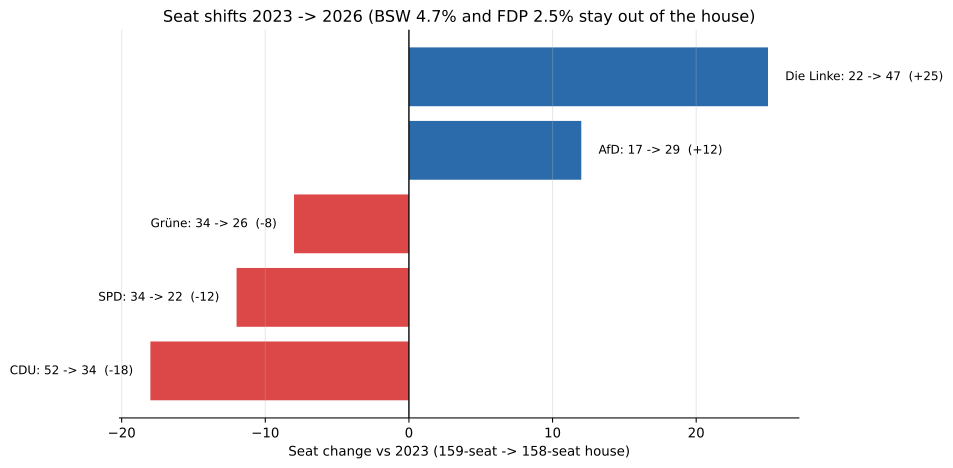
A note on the house size. Posts 1–2 ran the engine on a 130-seat base house (majority 66) as a simplification; the actual 2026 house has 158 seats (majority 80). Everything below is therefore re-run on the real 158-seat house — same allocation rule (largest-remainder, 5% threshold), same six-axis positions, same taboo set. The first thing the engine reproduces is the official allocation itself: applying allocate_seats(official votes, total=158) yields 47/34/29/26/22 — an exact match with the official result, seat for seat.
The final two weeks. Compared with the last polling window (6 polls, 13 Aug – 14 Sep), the election day result was a concentrated Linke surge: Die Linke +5.7, BSW +0.9, SPD +0.1, FDP −0.8, AfD −1.2, CDU −1.0, Grüne −1.4. No other party moved more than 1.4 points; the Linke moved 5.7. The post-election record attributes the surge to housing and tenants’ rights — the single most decisive issue for over 50% of voters in exit polls — and to Middle-East-related mobilization of young voters (including newly eligible 16–17-year-olds) in inner-city districts.
2. Where the result landed among the scenarios
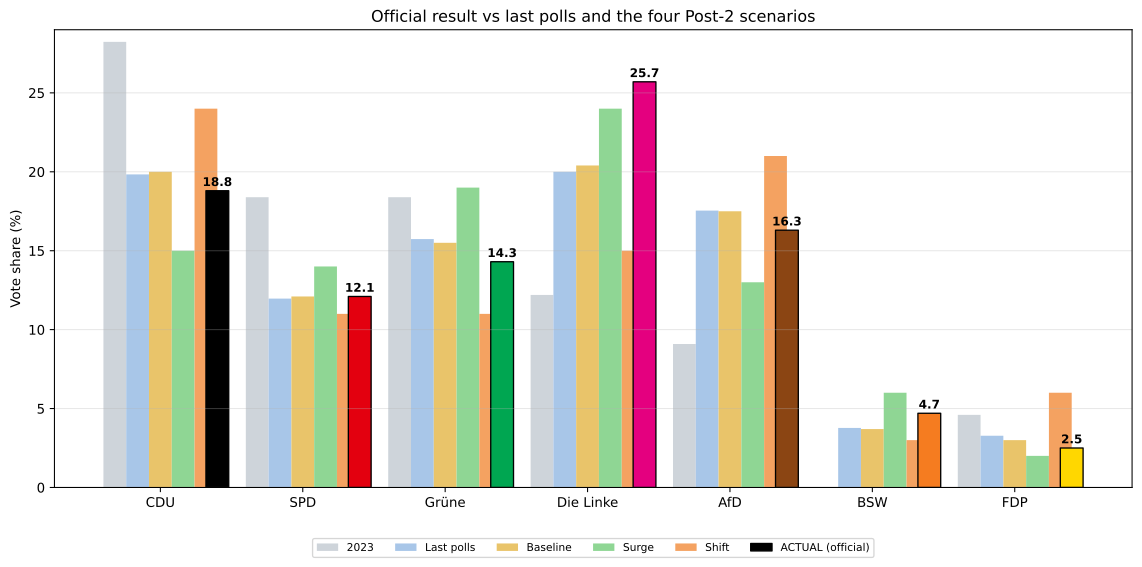
Distance to the Post 2 scenarios (root-mean-square of the vote-share deltas):
| Scenario | RM over 5 in-house parties | RM over all 7 |
|---|---|---|
| Current Baseline | 2.55 | 2.19 |
| Left-Green Surge | 3.28 | 2.82 |
| Conservative Shift / Firewall Breaks | 5.93 | 5.22 |
The result is not one of the four scenarios — it is the baseline plus a concentrated Linke surge. The left bloc (Linke+Grüne+SPD) gained +4.1 points overall (48.0 → 52.1) — about half of the full Left-Green Surge scenario (+9.0) — while the right bloc (CDU+AfD) lost −2.4. The Linke’s 25.7% even exceeds the Surge scenario’s 24.0%, but without the accompanying Greens/SPD/BSW movement the Surge implies. The Conservative Shift and Firewall Breaks scenarios are far away: the result landed on the left side of the baseline, not the right.
What matters most: the government question did not move. In the baseline and the Surge scenario alike, the most likely government is a left one without the CDU (RRG in the baseline; Linke+Grüne+BSW in the Surge, where BSW clears the threshold) — and the actual result gives RRG 47+26+22 = 95 of 158 seats, a +15 margin, up from the +9 margin the baseline polls projected. The flip scenario (T1 below) did not fire, and the only scenarios with a CDU-led government (Conservative Shift, Firewall Breaks) are the two the result is farthest from.
3. The power jump: prediction vs actual, same house
Here is where it gets interesting. Evaluate the prediction (the baseline polls of Post 2 §2) and the actual result in the same 158-seat house:
| Prediction (baseline polls) | Actual (official result) | |
|---|---|---|
| Seats | CDU 37 · Linke 38 · AfD 32 · Grüne 29 · SPD 22 | CDU 34 · Linke 47 · AfD 29 · Grüne 26 · SPD 22 |
| Largest pair (CDU+Linke) | 75 (< 80) | 81 (≥ 80) |
| Smallest trio (SPD+Grüne+AfD) | 83 (≥ 80) | 77 (< 80) |
| Perfect 5-way power tie | yes | no |
| Viable coalitions | RRG (89) · Kenia (88) | RRG (95) · Kenia (82) |
| Main coalition | RRG (naturalness 0.273) | RRG (naturalness 0.273) |
The prediction sat on the edge of the tie-break geometry: the CDU–Linke pair was 5 seats short of being a majority, and the smallest trio was 3 seats over. The final two weeks pushed the house across both lines at once.
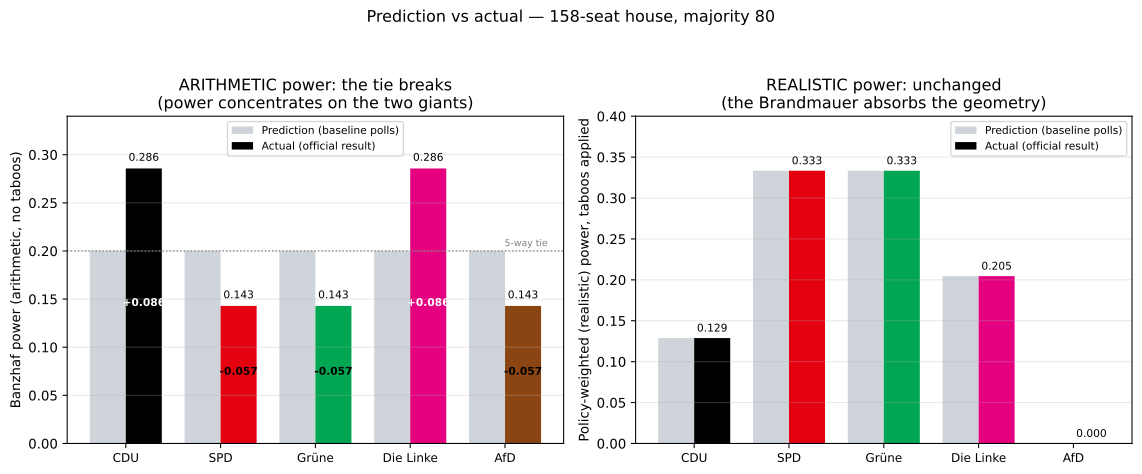
The arithmetic power jumped. In the predicted house the perfect 5-way tie held, so every party — including the AfD — had exactly 0.200 of the Banzhaf power. In the actual house the tie is broken and power concentrates on the two giants: the CDU and the Linke (the pair that now is a majority) each jump to 0.286 (Shapley–Shubik 0.300), while the SPD, the Grüne and the AfD all fall to 0.143 (0.133). The CDU — the party that just lost 18 seats — is now one of the two most powerful parties in the arithmetic of the house.
The realistic power did not move at all. The policy-weighted indices (each swing weighted by the naturalness of the resulting government, taboos applied) are identical in prediction and actual: SPD 0.333, Grüne 0.333, Linke 0.205, CDU 0.129, AfD 0.000. The reason is the one Post 2 kept repeating: realistic power depends on which coalitions can form, and the feasible set is unchanged — RRG and Kenia, exactly as before. The tie-break changed the house’s arithmetic; the Brandmauer and the CDU–Linke incompatibility absorbed it. The AfD’s 29 seats are arithmetically pivotal (0.143) and, at the same time, completely powerless in policy (0.000) — the “topology-only trap” of Post 2 §5.2, now measured on the real house.
4. The tipping points: we landed on both, by 1 seat and 3 seats
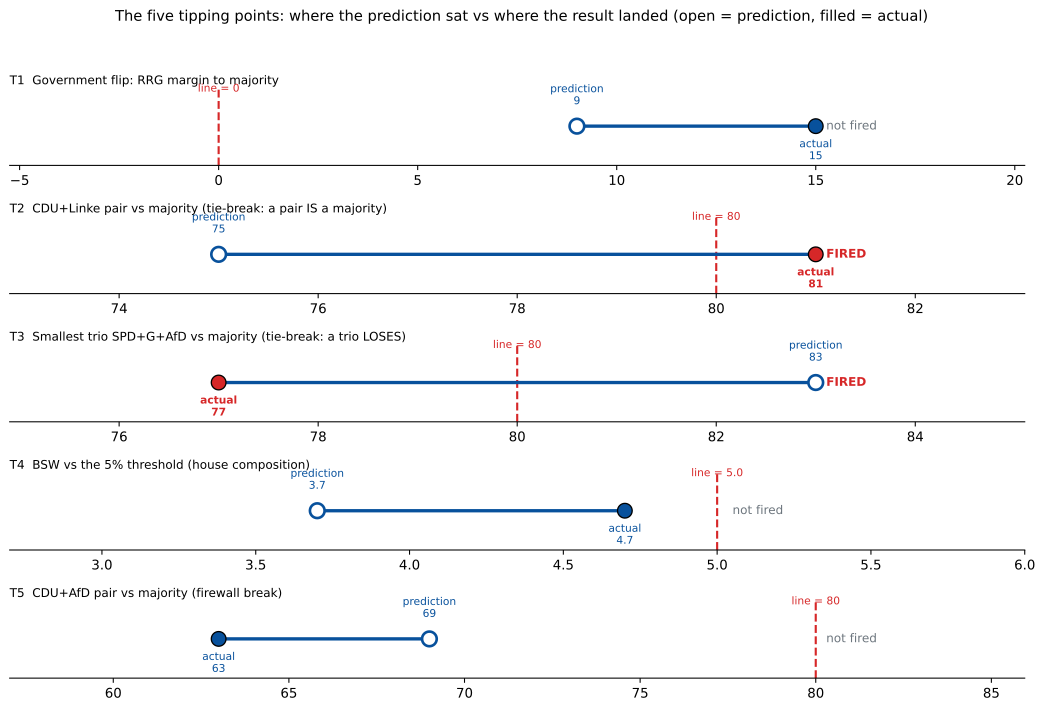
Post 2 §9.4–§9.5 identified five tipping points — the configurations at which something structural changes. Here is where the prediction sat and where the result landed:
| # | Tipping point | Prediction (158-seat) | Actual (158-seat) | Fired? |
|---|---|---|---|---|
| T1 | RRG falls below the majority (government flip to Kenia) | margin +9 | margin +15 | no — moved away |
| T2 | CDU+Linke pair reaches the majority (a pair is a majority) | 75 (5 short) | 81 (1 over) | yes |
| T3 | Smallest trio (SPD+Grüne+AfD) falls below the majority (a trio loses) | 83 (3 over) | 77 (3 short) | yes |
| T4 | BSW or FDP crosses the 5% line (house composition changes) | BSW 3.7 / FDP 3.0 | BSW 4.7 / FDP 2.5 | no — 0.3 pts short |
| T5 | Brandmauer breaks (CDU+AfD pair reaches the majority) | pair at 69 | pair at 63 | no — 17 short |
Two readings:
- The double tie-break (T2+T3) is the story of this election in the model’s terms. Both lines were crossed in the final two weeks, and both by the smallest margins the model tracks — 1 seat on the pair (81 vs 80) and 3 seats on the trio (77 vs 80). Post 2’s grid had computed exactly what a tie-break does: it redistributes arithmetic power to the two giants and moves the parliament’s center of gravity by up to 0.43 (largest on Mid-East). The actual result delivers exactly that — §5 shows the parliament moved 0.43 on Mid-East. Same mechanism, same magnitude, now on real data.
- The two levers the campaign could still pull stayed closed. The government flip (T1) moved away from the line (margin 9 → 15), and the threshold (T4) came within 0.3 points (BSW 4.7) but did not cross — had it crossed, Post 2 §9 says the parliament would have moved by up to 0.33 and a sixth party would be in the house. The firewall (T5) held with 17 seats of margin, as the post-election record confirms: all parties maintain the Brandmauer, and the CDU still rejects coalition with the Linke — which is why the post-election debate describes the Left–Green–SPD coalition (95 of 158) as the primary viable path, exactly as the engine ranks it.
5. The policy center of gravity
With the seat vector and the power indices fixed, the policy projections follow from the same seat-weighted formula as in Post 2:
| Vector (158-seat house) | Hou | Tra | Mid | Sec | Fis | Cli |
|---|---|---|---|---|---|---|
| Outgoing gov 2023 (CDU+SPD, 86) | 3.69 | 3.69 | 1.90 | 7.62 | 4.19 | 4.69 |
| Prediction gov (RRG, polls, 89) | 8.40 | 8.51 | 5.55 | 2.98 | 8.52 | 8.54 |
| ACTUAL gov (RRG, 95) | 8.55 | 8.57 | 5.88 | 2.84 | 8.66 | 8.56 |
| Kenia alternative (actual seats, 82) | 5.21 | 5.52 | 2.56 | 6.16 | 5.55 | 6.21 |
| Parliament, prediction (power-weighted) | 5.70 | 5.60 | 3.50 | 5.70 | 6.00 | 5.90 |
| Parliament, ACTUAL (power-weighted) | 5.86 | 5.71 | 3.93 | 5.57 | 6.14 | 6.00 |
| Parliament, ACTUAL (per-dimension power) | 6.40 | 5.93 | 3.52 | 5.60 | 6.88 | 6.15 |
(Hou = Housing, Tra = Transport, Mid = Mid-East, Sec = Security, Fis = Fiscal, Cli = Climate; 1 = left anchor, 10 = right anchor.)
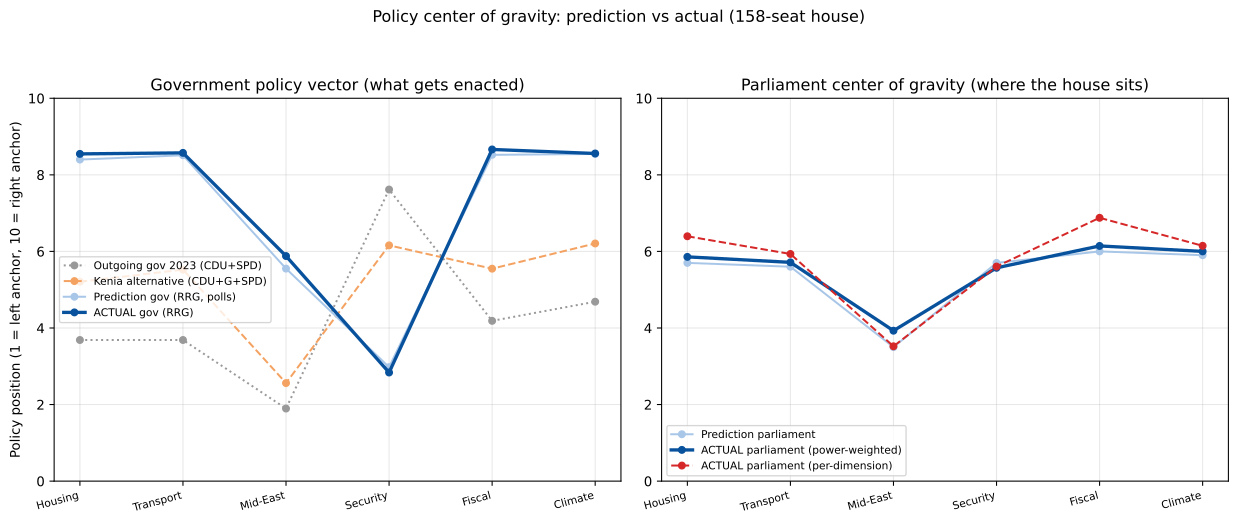
The government vector made the largest jump the series has produced. Outgoing → incoming: housing +4.86, transport +4.89, Mid-East +3.98, fiscal +4.48, climate +3.87, security −4.78 (toward the civil-rights pole). The post-election record’s own trajectory numbers track the engine closely: the record puts the incoming government’s housing at ~8.6 (engine: 8.55), mobility/climate at ~8.8 (engine: 8.57/8.56) and security at 3.1 (engine: 2.84), and the outgoing administration’s security at 7.6 — the engine’s CDU+SPD vector gives 7.62. The make-or-break file the record describes — the expropriation of large real-estate firms and the rent freeze (Mietendeckel) — sits exactly where the projection puts the government: 8.55 on housing, 1.45 points from the expropriation anchor (10.0).
Actual vs prediction: small, and concentrated on the mobilization axes. The government vector moved only +0.15 (housing), +0.06 (transport), +0.33 (Mid-East), −0.14 (security), +0.14 (fiscal), +0.01 (climate) between the polls and election day. Why so little, if the Linke surged 5.7 points? Because the government’s identity never changed — only its internal weights did: the Linke’s share of the RRG vector rose from 38/89 = 0.427 to 47/95 = 0.495 (Grüne 0.326 → 0.274, SPD 0.247 → 0.232). And Post 2 §9.3 said exactly where that kind of re-weighting shows: on the axes with the largest stance gap inside the coalition — the Mid-East, where the Linke (8.5) and the SPD (2.5) are 6 points apart. The largest government delta is on the Mid-East (+0.33), then housing (+0.15) — the two gaps of 6.0 and 4.5.
The parliament stayed almost exactly where the model said it would. Actual vs prediction: +0.16 housing, +0.11 transport, +0.43 Mid-East, −0.13 security, +0.14 fiscal, +0.10 climate. That is not zero — the double tie-break moved it, by the predicted amount and in the predicted direction (toward the two giants, largest on the Mid-East) — but it is the parliament’s normal movement under a tie-break, not a structural shift. The house’s center of gravity remains at ~5.9/5.7/3.9/5.6/6.1/6.0: moderate on housing, firmly on the Staatsräson pole of the Mid-East, roughly centered on security. What gets enacted (the government, at the left anchors) is far from where the house sits — Post 2’s government-vs-parliament distinction, confirmed on the first real result.
6. Where the winner does not fit: Die Linke vs the status quo
The cleanest way to read the post-election record is to measure where the winning party sits relative to the centre of gravity of the house it just entered — the model’s parliament projection (power-weighted, 158-seat house, §5):
| Axis | Die Linke | Parliament CoG | Gap (Linke − CoG) | Distance |
|---|---|---|---|---|
| Mid-East | 8.5 | 3.93 | +4.57 | 4.57 |
| Housing | 10.0 | 5.86 | +4.14 | 4.14 |
| Security | 1.5 | 5.57 | −4.07 | 4.07 |
| Fiscal | 10.0 | 6.14 | +3.86 | 3.86 |
| Transport | 9.5 | 5.71 | +3.79 | 3.79 |
| Climate | 9.0 | 6.00 | +3.00 | 3.00 |
(Sorted by distance: the axes where the winner sits farthest from the house’s status quo.)
The top three axes by distance — Mid-East, housing, security — are exactly the three topics the post-election record lists as driving the debate. In the record’s own ordering housing is #1 (“the single most decisive issue for over 50% of voters”) and the Mid-East #2; by distance the Mid-East leads by 0.4 points. That is the status-quo mismatch in one table: the winning party governs from a position 4+ points away from the centre of the house on precisely the axes the campaign mobilized on. The chain the record implies — controversy on those topics, debates steered toward them, attacks aimed at the winner on them — is, in the model, a direct consequence of the Linke sitting farthest from the CoG on exactly those axes.
The three topics have three different structures, and the record’s wording reflects each one:
- The Mid-East is the coordinated-attack axis. In the house, the CDU (1.5) and the AfD (1.0) — the two out-of-government parties — sit 0.5 points apart at the pole opposite the Linke (8.5), and even the in-government SPD (2.5) and Grüne (4.0) stand 6.0 and 4.5 points from it. It is the only axis where all four non-Linke parties in the house cluster on one side (1.0–4.0) while the largest party sits alone on the other — the natural axis for a united opposition critique. And, as §7 shows, it is the only axis where re-weighting the debate would flip the “natural” government to a CDU-led one.
- Housing is the internal-government axis. Inside RRG the Grüne (8.5) stand with the Linke (10.0) against the SPD (5.5), so the 4.14 gap to the status quo plays out as an internal make-or-break (the expropriation red line, §5) rather than as an opposition attack. The record’s framing — the Linke’s surge “provides a direct mandate” to execute expropriation and the rent freeze — is the coalition-internal version of the same distance.
- Security is the divided axis. The CDU (9.0) and the AfD (9.5) sit 7.5 and 8.0 points from the Linke (1.5), but the Grüne (3.0) and the SPD (5.5) stand in between — so the right can attack on security without being able to unite the house behind the attack. That is precisely what the record describes: “the debate remains divided between conservative demands for expanded law enforcement powers (pushed by CDU and AfD) and left-wing demands for civil rights protections.”
The two over-focused topics (housing, Mid-East) are also, as §5 showed, the government vector’s two largest deltas (+0.15, +0.33): the campaign’s attention structure, the coalition’s sensitivity structure, and the winner’s distance from the status quo all point at the same axes.
Smear and attack campaigns move shares, not positions — and that has a visible limit. Attacks on the center parties (CDU, SPD) are pure input-1 levers: they move vote shares, hence seat weights — they cannot move a party’s stance on any axis, and they cannot move the government vector beyond the re-weighting that follows. The result shows both the effect and the limit: the center lost or stagnated (CDU −1.0 in the final window and −9.4 points since 2023; SPD flat at 12.1 after collapsing from 18.4), the right bloc lost −2.4 overall, and — because the government’s composition never changed — the entire effect of two years of center erosion on the enacted policy vector is a ≤0.33 re-weighting, not a direction change. The one structural effect the center’s decline did have is geometric: the CDU kept 34 seats, which — with the Linke’s 47 — is what pushed the CDU+Linke pair to 81 and broke the tie (T2). The attacks helped build the power jump without being able to direct it.
The firewall is the record’s quietest — and the model’s loudest — finding. The AfD gained 12 seats (29) but lost in the final window (−1.2), and the post-election record confirms that all parties maintain the Brandmauer. In the model’s terms that is the entire story of the AfD’s result: the tie-break made the AfD arithmetically pivotal (0.143 — it swings the house in combinations no coalition may form), and the firewall converted that back to 0.000 realistic power. The AfD’s 29 seats did not buy a single point of government policy — the government’s vector moved left, not right, in the final window. Post 2 §10.4 called the firewall the model’s biggest narrative lever (worth 1.1–3.3 points on every axis); the post-election result is the first real-world observation of it holding. Norms of that kind are made, kept and broken by public argument, not by seat counts — and this one held.
And the closest call of the election was a model line, not a podium position. BSW’s 4.7% sits 0.3 points below the 5% threshold — the T4 tipping point. The post-election record notes the BSW’s continued relevance in the debate; the model notes that the single most likely structural event of the next election, if the current band holds, is BSW entry — which Post 2 §9 priced at up to 0.33 of parliament movement and a change in the set of feasible coalitions.
7. Re-weighting the axes: when would a CDU-led government be “natural”?
Setup. The engine’s naturalness (the product of pairwise policy proximities, Post 1) treats the six axes as equally important. But a campaign never argues in an equal-weight space: salient topics weigh more. Parties can decide where to put the focus, media can follow and coalitions that used to be natural find their red lines or just simply re-prioritize. If we re-weight the axes — change the importance of each dimension — the parties’ distances change, and with them the naturalness ranking of the viable coalitions. In the real house the viable governments are exactly two (RRG 95, Kenia 82 — every other majority coalition contains a forbidden pair), so the question is a head-to-head: under which axis weights is the CDU-led coalition the more natural government?
How the distance is computed. Every party is a point in the six-axis policy space of the position matrix (Post 1 §3) — the CDU at (2.5, 2.5, 1.5, 9.0, 3.0, 3.5), the SPD at (5.5, 5.5, 2.5, 5.5, 6.0, 6.5), the Grüne at (8.5, 9.5, 4.0, 3.0, 8.5, 9.5) and Die Linke at (10.0, 9.5, 8.5, 1.5, 10.0, 9.0) for (Housing, Transport, Mid-East, Security, Fiscal, Climate). The engine’s pairwise distance is the Euclidean distance between those points,
d(p, q) = √ Σᵢ ( xₚ,ᵢ − x_q,ᵢ )² over the six axes i
which lives on a 0 → 9√6 ≈ 22.0 scale (0 = identical on every axis, 22.0 = opposite on every axis). The engine maps it to a proximity in [0, 1] by dividing by that maximum,
proximity(p, q) = 1 − d(p, q) / ( 9√6 )
and the naturalness of a coalition is the product of the proximities of all its pairs (Post 1 §2): RRG multiplies Linke–Grüne, Linke–SPD and Grüne–SPD; Kenia multiplies CDU–Grüne, CDU–SPD and Grüne–SPD. At equal weights this is the engine’s naturalness (RRG 0.273 vs Kenia 0.172), and the CDU–Grüne pair sits at 0.369 — the weakest pair in either coalition.
What re-weighting does. Re-weighting an axis is exactly what a salient topic does to this space: it stretches it along that axis. Give the Mid-East axis a weight λ (the other five stay at 1) and the distance becomes the weighted Euclidean distance
d_λ(p, q) = √ ( Σᵢ≠Mid ( xₚ,ᵢ − x_q,ᵢ )² + λ ( xₚ,Mid − x_q,Mid )² )
(first sum over the other five axes), with the normalization following the stretch — the maximum weighted distance is 9√(5+λ), so proximity_λ(p, q) = 1 − d_λ(p, q) / ( 9√(5+λ) ). A pair’s proximity then moves in the direction set by one comparison only — how far apart the pair is on the emphasized axis, relative to its gaps on the other five:
- a pair close on the emphasized axis is stretched less than the space itself — its normalized distance shrinks and its proximity rises;
- a pair far on the emphasized axis is stretched more than the space — its proximity falls.
As λ → ∞ the other five axes drop out entirely and the proximity of two parties reduces to 1 minus their gap on the emphasized axis (1 − Δ/9): the space collapses onto its one-dimensional shadow along that axis. The sweep λ = 1 → 16 moves continuously between the full six-dimensional geometry and that shadow — nothing about the parties changes, only which dimension the distance listens to.
In plain terms. Picture the parties as cities on a map, and the distance between two parties as the distance between two cities. Emphasizing one axis is like stretching the map along that one direction: cities that were already close along the stretch get even closer, cities that were far apart along it get pushed farther — while everything in the other five directions is compressed by comparison. No city has moved; only the shape of the map has changed.
That is exactly what it means for a single topic to dominate a debate. On the Mid-East axis the CDU (1.5) sits next to both its Kenia partners — the SPD (2.5) and the Grüne (4.0) — while Die Linke (8.5) sits alone at the opposite end, 6 points from the SPD and 4.5 from the Grüne. If the Mid-East were the only issue being talked about, the CDU would read as a natural partner of both, and the Linke as an unnatural partner of either — no matter what the five other issues say. The λ dial is that made continuous: λ = 1 is the full six-topic conversation, and the larger λ, the more the ranking is decided by a single topic.
Concrete case, Mid-East at λ = 8: the CDU and the Grüne are only 2.5 apart on the Mid-East (1.5 vs 4.0) — the smallest of their six gaps — and their proximity rises from 0.369 to 0.525; Die Linke and the SPD are 6.0 apart (8.5 vs 2.5) — the largest of their six gaps — and their proximity falls from 0.523 to 0.413. Same parties, same five other axes: the change of focus alone re-arranged the geometry.
Method. Raise the weight λ of one axis (the others stay at 1), from λ = 1 (equal weights — where the weighted computation reproduces the engine’s naturalness exactly: RRG 0.273 vs Kenia 0.172) up to λ = 16, and recompute the proximities and the two coalitions’ naturalness with the weighted distances.
Result: only one of the six axes can flip the ranking.
| Axis emphasized (λ: 1 → 16) | Leader at λ = 16 | Flip point |
|---|---|---|
| Housing | RRG (0.276 vs 0.155) | none — the left’s lead widens |
| Transport | RRG (0.280 vs 0.103) | none |
| Mid-East | Kenia (0.166 vs 0.370) | λ ≈ 3.1 |
| Security | RRG (0.315 vs 0.154) | none |
| Fiscal | RRG (0.315 vs 0.183) | none |
| Climate | RRG (0.379 vs 0.155) | none |
Interpretive “salience” regimes (the weight profile a campaign induces): mid-east-first (Mid-East 8×) makes Kenia the natural government (0.304 vs 0.186); order-first (security + Mid-East + fiscal at 6×) keeps RRG but narrows the margin to 1.15 (0.249 vs 0.217, from 1.59 at equal weights); housing-first, security-first, climate-first, economy-first and mobility-first all keep RRG — mostly with a wider margin (housing-first: 0.275 vs 0.159).
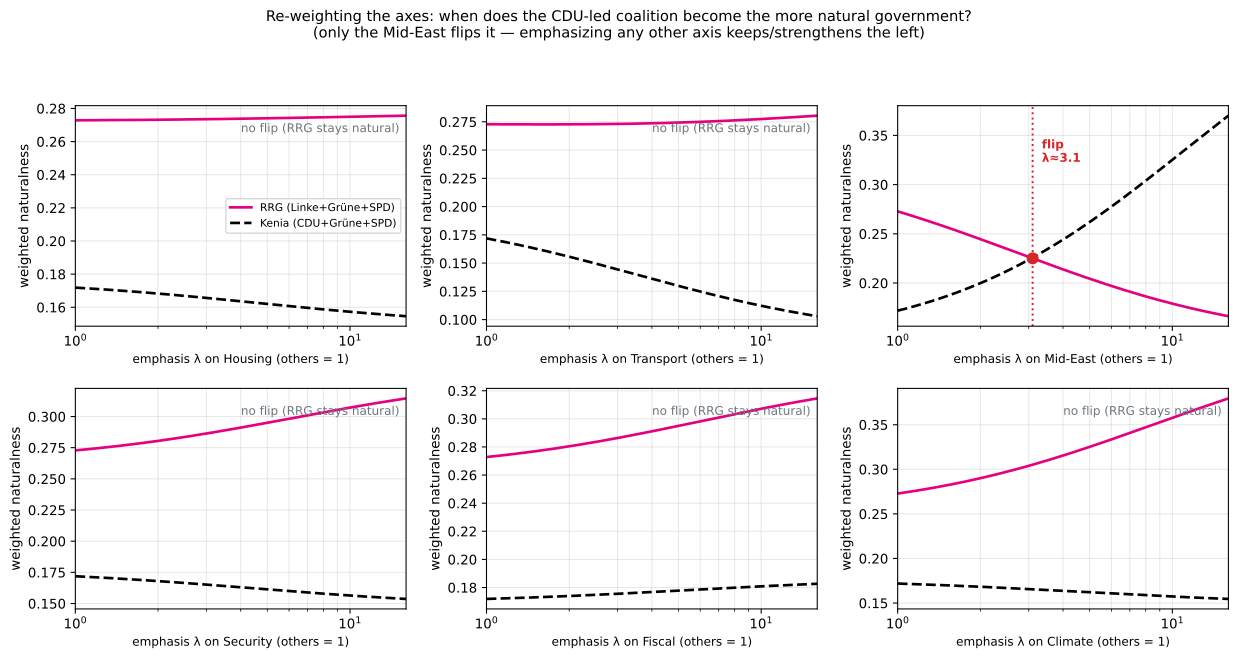
Why only the Mid-East. The CDU is 5.5–7.0 points away from the Grüne on five of the six axes (the exception is the Mid-East, where they are 2.5 apart) — so the CDU–Grüne pair (equal-weight proximity 0.369) is the weakest pair inside any viable coalition, and emphasizing any of those five axes penalizes Kenia — the only viable coalition containing that pair — more than it penalizes RRG. The Mid-East is the structural exception: there the CDU (1.5) and the Grüne (4.0) sit close together while the Linke (8.5) is the outlier, 6 points from the SPD (2.5). Weighting the Mid-East 8× pulls the CDU–Grüne proximity up (0.369 → 0.525) and pushes both left pairs apart (Linke–SPD 0.523 → 0.413; Grüne–Linke 0.763 → 0.599) — and at λ ≈ 3.1 (the Mid-East weighted about three times as much as each of the other axes) the ranking flips: the CDU-led coalition becomes the more natural one.
Read with §6. The Mid-East is simultaneously (a) the axis where the winning party sits farthest from the status quo (4.57), (b) the only axis where the whole other parties in the house align against the Linke, and (c) the only axis where re-weighting the debate would flip the natural government to the CDU. It is the axis of maximum structural instability — and the record shows the campaign did mobilize around it, with two opposing model effects: on the vote-share side it worked for the Linke (the mobilization axis of the +5.7 surge), while on the naturalness side it worked against the left (it is the axis that makes Kenia natural). The seat result (RRG 95) says the vote-share effect won — but if the Mid-East’s effective salience had held at λ ≥ 3.1 through the coalition talks, the “natural” government the model would point to is the CDU-led one, not the RRG.
Scope note. Re-weighting can only reorder the two viable governments, not create a third. There is no “Grüne-led” or “SPD-led” viable government in this house: the only majority pair (Linke+CDU, 81) is forbidden, and every viable three-party coalition contains both the Grüne and the SPD — they are the common hinge of RRG and Kenia. What the axis weights change is not who is possible but which of the two is attractive — and the taboos (a different lever, Post 2 §8) are what keep a third option (CDU+AfD) off the table at all.
- The winner’s distance from the status quo points at the debate. The Linke sits 4+ points from the parliament’s center of gravity on exactly three axes — Mid-East (4.57), housing (4.14), security (4.07) — and those are the record’s three debate topics. The Mid-East is the axis of maximum structural instability: the whole in-house opposition clusters against the Linke there, and it is the only axis whose re-weighting (λ ≈ 3.1) flips the “natural” government from RRG to a CDU-led Kenia — while emphasizing any other axis keeps or strengthens the left’s naturalness.
Bottom line
- The engine reproduces the official result seat for seat (47/34/29/ 26/22 on the real 158-seat house) — and the result is not one of the four scenarios, but the baseline plus a concentrated Linke surge (+5.7 in the final window; left bloc +4.1, right bloc −2.4).
- Red–Red–Green governs with 95 of 158 seats (margin +15, up from the projected +9) — the government flip never came, and the firewall held with 17 seats of margin.
- We landed on both power-geometry tipping points at once, by 1 seat and 3 seats. The CDU+Linke pair crossed into majority (81 vs 80) and the smallest trio fell out (77 vs 80) — the double tie-break of Post 2 §9.4, now measured on the real house.
- Arithmetic power jumped; realistic power did not. The perfect 5-way tie (0.200 each) became CDU/Linke 0.286 and SPD/Grüne/AfD 0.143 — while the policy-weighted indices are identical to the prediction (SPD/Grüne 0.333, Linke 0.205, CDU 0.129, AfD 0.000): the Brandmauer absorbed the entire geometry change. The AfD is arithmetically pivotal and policy-irrelevant at the same time.
- The government vector made the model’s biggest leftward jump (housing 3.69 → 8.55, security 7.62 → 2.84 between administrations), and actual-vs-poll difference was small (+0.33 max, on the Mid-East) because only the coalition’s internal weights changed — the Linke now prices 0.495 of the vector, and the two over-focused campaign topics (Mid-East, housing) are exactly the two largest deltas.
- The parliament’s center of gravity barely moved (+0.43 max, on the Mid-East — the tie-break’s predicted signature): what gets enacted sits at the left anchors; where the house sits is almost unchanged.
- The campaign’s narratives and the model’s levers line up: over-focus moves shares toward the anchor party of the over-focused axis (input 1); attacks move shares but not positions, so their effect on enacted policy is capped at re-weighting; and the firewall — a pure narrative object — is what keeps 29 far-right seats at 0.000 policy power.
All figures are computed by postelection_analysis.py (official result from data/berlin_2026_results.csv, run through the unchanged scenario_engine.py of Posts 1–2 on the real 158-seat house, majority 80; the tipping-point diagnostics and both power-index families come from the same run) and postelection_depth.py (the §6 Linke-vs-CoG distances and the §7 weighted-naturalness sweep), with the charts by postelection_charts.py (the six SVGs above); all are reproducible from this folder. The post-election context (exit-poll issue salience, mobilization drivers, coalition statements) is from the collected post-election record. This is an analysis of the result, not a forecast of the coalition talks — the RRG’s internal weights, not its existence, are what the talks will decide.