
Berlin Elections 2026 - (I) Looking into the party landscape
Published:
Who Really Holds Power in Berlin?
A voting-game analysis of the Abgeordnetenhaus (2023 results)
Analysis of the power structure of the Berlin Abgeordnetenhaus as elected on 12 February 2023 — 159 seats, 80 needed for a majority. Seat counts are the official 2023 results (source); power indices and policy projections are computed with the cooperativegames package. This is an analysis of policy power — no vote-intent polls are used, only party policy positions.
Before a government is formed, the real question in a parliamentary system is not who won the most seats, but who can govern — and what they will govern. In Berlin’s 2023 result no party holds a majority on its own, so the election is really a contest over coalitions. This article uses the mathematics of cooperative (voting) games to answer two questions:
- Who holds power? Not just who has the most seats, but who is pivotal — whose participation decides whether a coalition can command a majority.
- What will policy look like? Given that parties only govern with partners they can actually stand next to, which way will the governing coalition pull each policy dimension?
We separate arithmetic power (Part 1) from realistic power (Part 2), because the difference between the two is where the politics actually is.
Throughout, we introduce the concepts and assumptions used to model the result, and we draw on public policy data and party positions — not vote-intent polls — to characterise where each party stands.
1. Power in voting games — why and how
Why seats are not enough
In a simple majority game, a party’s influence is not determined by how many seats it holds, but by how often it is decisive. Consider two extremes:
- A large party that is dispensable — every majority works with or without it — has little bargaining power despite its size.
- A small party that is essential to every workable majority is a kingmaker, wielding influence far beyond its seat share.
Voting-game theory makes this precise. The parliament is modelled as a weighted voting game [q; w₁, w₂, …, wₙ], where wᵢ is a party’s seats and q is the quota (a simple majority of the 159-seat house is 80). A coalition wins if its seats reach the quota. Power is then measured by how often a party is the decisive member of a winning coalition.
The two indices we use
| Index | Intuition | Question it answers |
|---|---|---|
| Banzhaf | A party is a swing voter when adding it turns a losing coalition into a winning one. The index counts how often this happens. | How often is this party decisive? |
| Shapley–Shubik | Parties join a coalition in random order; the pivotal party is the one that pushes the running total over the quota. The index is the probability a party is pivotal. | What is this party’s expected bargaining contribution? |
Both are computed exactly by the package (the Banzhaf index via an O(n·q) dynamic program, so even a full 159-seat house is tractable).
The result: arithmetic power in Berlin 2023
Applying the two indices to the official 2023 result — a simple majority of 80 seats in the 159-seat house — gives each party’s arithmetic power. The table lists each party’s seat count and seat share next to its Banzhaf and Shapley–Shubik indices; the chart below plots the same against raw seat share (black dashed line), so you can see exactly where power departs from seats.
| Party | Seats | Seat share | Banzhaf | Shapley–Shubik |
|---|---|---|---|---|
| CDU | 52 | 32.7% | 0.385 | 0.400 |
| SPD | 34 | 21.4% | 0.231 | 0.233 |
| Grüne | 34 | 21.4% | 0.231 | 0.233 |
| Die Linke | 22 | 13.8% | 0.077 | 0.067 |
| AfD | 17 | 10.7% | 0.077 | 0.067 |
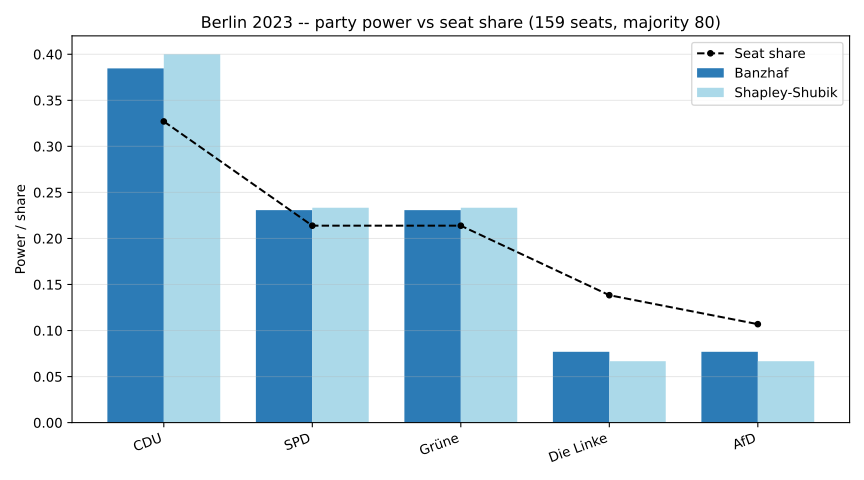
Three things jump out. First, CDU is not just the largest party — it is the pivot: its power (0.38–0.40) sits well above its 32.7% seat share, because a majority of 80 is hard to build without it. Second, SPD and the Greens are tied (0.23 each) — both are essential swing parties that CDU needs to reach
- Third, Die Linke and AfD are tied at the bottom (0.077 each): both are too small to be decisive on their own, so their power is conditional on which side of the house they can pull. (The FDP won no seats in 2023 and BSW had not yet been founded, so neither is in this game.)
2. Policy topology — why the policy dimension matters
Not every winning coalition is equally likely
Part 1 counts all winning coalitions as if they were equally plausible. They are not. A coalition of parties that agree on policy is far more likely to form — and to survive — than one that clashes on every file. The policy topology (how parties are arranged in policy space) determines which of the arithmetic coalitions are realistic.
Ignoring this produces a systematic error: it over-weights policy-incoherent coalitions. In Berlin the sharpest case is the AfD: the current state of German politics rules out any coalition that includes it — not merely a CDU–AfD pairing, but the AfD with every other party. This is the so-called Brandmauer (firewall): a common-knowledge taboo that the AfD is excluded from governing altogether. A model that cannot see this will forecast a far more rightward government than reality will deliver.
The method: weight coalitions by policy naturalness, then encode common knowledge
We do two things to turn arithmetic power into realistic power:
- Policy naturalness. For each winning coalition we compute a naturalness weight = the product of the pairwise policy proximities of its members (proximity = 1 − distance in the 6-dimensional policy space). A coherent coalition scores high; a patchwork of ideological opposites scores near zero. We then average each coalition’s policy position (seat-weighted) and weight the average by naturalness. This yields the likely governing coalition’s position on each policy axis.
- Common knowledge (the Brandmauer). We add a
forbidden_pairsfilter that removes any coalition containing a politically infeasible pairing. The Brandmauer is encoded as every pair that involves the AfD (AfD × CDU, AfD × SPD, AfD × Grüne, AfD × Die Linke), so any coalition containing the AfD is excluded — not just CDU+AfD. This encodes what everyone already knows but a pure arithmetic model cannot.
The result: realistic policy, with and without the firewall
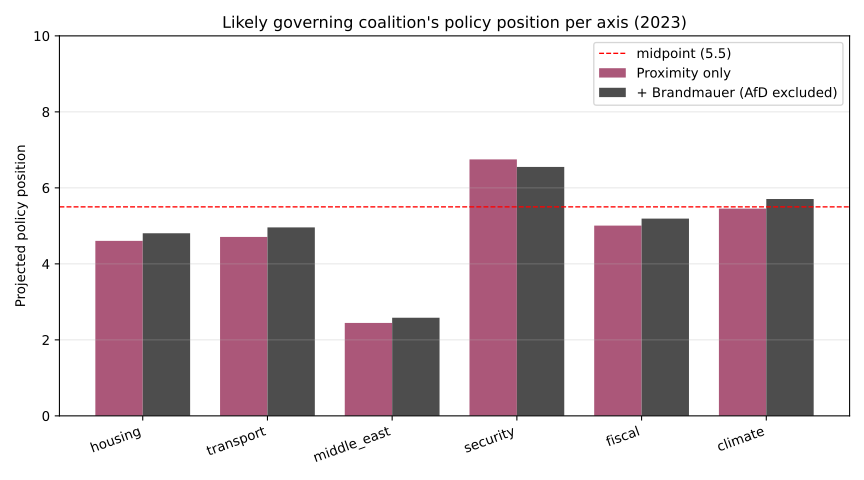
| Axis | Proximity only | + Brandmauer (AfD excluded) | Reading | Direction (which side) |
|---|---|---|---|---|
| security | 6.75 | 6.55 | law-enforcement side (robust) | law-enforcement / surveillance |
| middle_east | 2.45 | 2.58 | Staatsräson side (robust) | Staatsräson / pro-Israel |
| housing | 4.61 | 4.81 | near the centre | slightly free-market / laissez-faire |
| transport | 4.71 | 4.96 | near the centre | slightly pro-car / car-friendly |
| fiscal | 5.01 | 5.19 | near the centre | slightly austerity / debt-brake |
| climate | 5.45 | 5.71 | slightly right of centre | slightly toward climate action |
(Scale 1→10, midpoint 5.5. Lower = the “left anchor” of each axis, higher = the “right anchor”.)
Which side, in plain terms. On the economic axes the realistic projection sits just on the free-market / fiscally-conservative side of centre: housing leans slightly toward the market (no rent caps), transport slightly pro-car, and fiscal slightly toward the debt-brake / austerity — i.e. a mild laissez-faire / economically-right tilt, not a decisive one. Climate leans the other way (slightly toward accelerated neutrality / more climate action). Security is law-enforcement-leaning and the Middle East leans Staatsräson. So the likely government is centrist overall, with a mild free-market tilt on the economic axes — not a right-wing government, but not left either. The direction is the same in both columns (proximity-only and Brandmauer), so it is robust to the firewall assumption.
The most natural feasible coalitions:
- Proximity only: CDU+SPD (0.38), CDU+Grüne (0.17), CDU+SPD+AfD (0.16), SPD+Grüne+Linke (0.13), CDU+SPD+Grüne (0.07).
- With the Brandmauer: CDU+SPD (0.48), CDU+Grüne (0.22), SPD+Grüne+Linke (0.16), CDU+SPD+Grüne (0.09) — every AfD coalition (e.g. the CDU+SPD+AfD above) is now removed from the feasible set.
The takeaway. The CDU–SPD grand coalition is by far the most natural government — and it is exactly the one that was formed (the Wegner senate). Encode the Brandmauer (exclude the AfD from every coalition) and CDU+SPD becomes even more dominant (0.48), because the entire AfD-inclusive right bloc is removed from the feasible set. The likely policy is centrist: housing, transport and fiscal sit near the middle, climate is slightly right of centre, security leans law-enforcement and the Middle East leans Staatsräson — those two are the robust, direction-setting findings. This is the whole point of doing the analysis in two layers: arithmetic power tells you who is strong; policy topology + common knowledge tells you what they will actually do.
3. Data sources and methodology
All inputs are policy positions and policy-opinion data — not opinion polls and not vote-intent. We never ask “who will voters choose?”; we ask “where does each party stand on each policy?”.
Sources
| Source | What it provides | Role | Direct links |
|---|---|---|---|
| Wahl-O-Mat (bpb / LZPb) | Parties’ answers to ~38 standardised policy statements (agree / neutral / disagree) across the election. | Primary structured record of party positions. | Wahl-O-Mat portal |
| WahlSwiper / VoteSwiper (Univ. Freiburg, Prof. U. Wagschal) | Spatial political-science model (Gal–Tan + left–right) giving party coordinates and pairwise agreement percentages. | Independent cross-check / spatial validation of positions. | VoteSwiper platform · Univ. Freiburg study portal |
| Policy audit — housing (Berliner Mieterverein, Deutscher Mieterbund) | Structured party comparisons (Wahlprüfsteine) on housing / rent policy. | Grounds the housing axis in concrete policy commitments. | Berliner Mieterverein · Deutscher Mieterbund Parteienvergleich |
| Policy audit — transport & infrastructure (Aktionsbündnis A100 stoppen!, Grüne Fraktion Berlin) | Structured party comparisons on transport / the A100 question. | Grounds the transport axis in concrete policy commitments. | A100 stoppen! · Grüne Fraktion Berlin A100 dossier |
| Media policy comparisons (Tagesspiegel Data Lab, rbb24) | Editorial party-positioning matrices built from manifestos and voting records. | Fills gaps and corroborates the above. | rbb24 · Tagesspiegel Interaktiv / Data Lab |
From stances to numeric scores (weighted average)
Each policy axis is built from several underlying policy items. For a party and an axis, we score each item xᵢ ∈ {−1, 0, +1} (against / neutral / for the axis’s “high” pole) and assign it a thematic weight wᵢ reflecting its importance within the axis. The party’s axis score is the weighted average, mapped onto the 1–10 scale:
S = 1.0 + 9.0 × ( Σᵢ w·xᵢ + Σᵢ w ) / ( 2 · Σᵢ w )
This is a standard rescaling of a weighted mean: it lands at 1.0 when the party opposes every item, 10.0 when it supports every item, and 5.5 when its weighted stance is balanced. The result is the 6-axis position matrix used throughout this article:
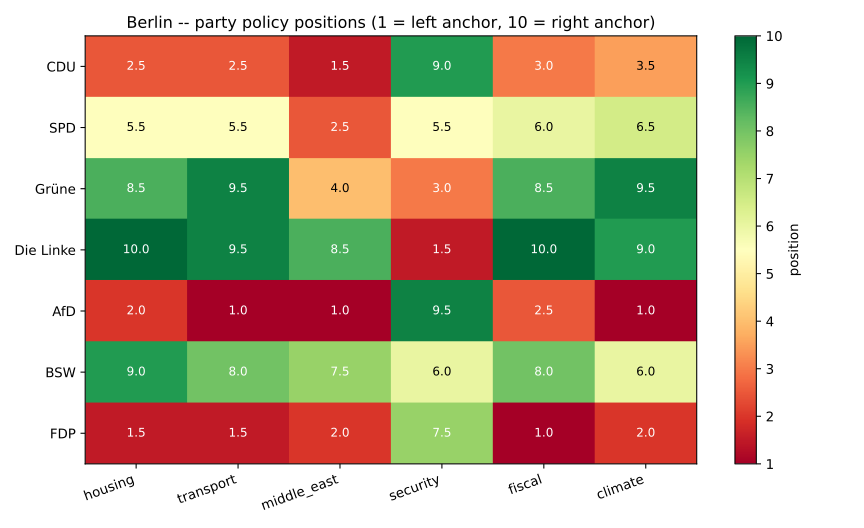
| Party | Housing | Transport | Mid-East | Security | Fiscal | Climate |
|---|---|---|---|---|---|---|
| CDU | 2.5 | 2.5 | 1.5 | 9.0 | 3.0 | 3.5 |
| SPD | 5.5 | 5.5 | 2.5 | 5.5 | 6.0 | 6.5 |
| Grüne | 8.5 | 9.5 | 4.0 | 3.0 | 8.5 | 9.5 |
| Die Linke | 10.0 | 9.5 | 8.5 | 1.5 | 10.0 | 9.0 |
| AfD | 2.0 | 1.0 | 1.0 | 9.5 | 2.5 | 1.0 |
| BSW | 9.0 | 8.0 | 7.5 | 6.0 | 8.0 | 6.0 |
| FDP | 1.5 | 1.5 | 2.0 | 7.5 | 1.0 | 2.0 |
Methodological caveat — the policy scores are heuristic, not a robust science. No number in the matrix above is the output of a validated survey or measurement instrument. Each party’s score on each of the six axes was inferred by the author from the sources listed above (Wahl-O-Mat / WahlSwiper statements, Wahlprüfsteine, editorial matrices) through a transparent but heuristic coding of qualitative stances onto the 1–10 scale (the weighted-average formula above). The method is reproducible and documented, but the exact score a party receives depends on which underlying items are chosen, how they are weighted, and how each stance is coded — i.e. it is expert judgement, not a robust science. Read the directions and relative ordering of the parties as the robust findings; treat the specific values as a best-effort encoding, not precise measurements.
BSW and FDP are shown because they are part of the current (pre-2026) party landscape. Neither held seats in the 2023 result used for the power simulation (BSW was founded afterwards; the FDP fell below the 5% threshold), so they do not appear in the power tables of Parts 1–2 — but they are full contenders for 2026.
Axis anchors: Housing 1 = free market / no rent caps → 10 = expropriation / rent freeze. Transport 1 = pro-car / A100 → 10 = transit-first / car-free. Mid-East 1 = Staatsräson / funding clauses → 10 = pro-Palestinian / protest, civil and humanitarian rights. Security 1 = civil rights / anti-profiling → 10 = law-enforcement / surveillance. Fiscal 1 = austerity / debt-brake → 10 = debt reform / borrowing. Climate 1 = market / sceptical → 10 = accelerated neutrality.
4. Where each party stands — an opinionated read
The numbers above are descriptive; this section is our take on what they mean. Power and position together tell you who can govern, and what they will do.
CDU — the indispensable pivot (52 seats · power 0.38–0.40)
CDU’s power (0.38–0.40) is well above its 32.7% seat share because a majority of 80 is hard to reach without its 52 seats: CDU+SPD (86) and CDU+Grüne (86) both clear the quota, so CDU can choose its partner. Its profile is unambiguously conservative — free-market housing (2.5), pro-car transport (2.5), hard security (9.0), fiscal discipline (3.0), market climate (3.5), maximalist Staatsräson (1.5). Our read: CDU is the kingmaker, and its conservative defaults set the floor for any government. But in a CDU+SPD or CDU+SPD+Grüne government it must compromise toward the centre — and the 2023 outcome (the CDU–SPD grand coalition) confirms exactly that: CDU’s power is real, but it is exercised through a centrist partner, not alone.
SPD — the centrist hinge (34 seats · power 0.23)
SPD sits near the middle on almost every axis (housing 5.5, transport 5.5, security 5.5, fiscal 6.0, climate 6.5) and is tied with the Greens as the essential swing party. Our read: SPD is the natural partner for CDU — CDU+SPD is the single most natural government (0.38, rising to 0.47 with the firewall). SPD’s centrality is its asset: it is the bridge that makes a CDU government workable, and it trades that centrality for the vice-chancellery and the key ministries. In the CDU–SPD grand coalition, SPD is the party that pulls policy toward the centre — which is why the projected policy is centrist rather than CDU-conservative.
Grüne — the climate-and-housing pole, tied with SPD (34 seats · power 0.23)
Grüne leads on climate (9.5), housing (8.5) and transport (9.5), is moderate on the Middle East (4.0) and civil-rights oriented on security (3.0). Our read: Grüne is the other essential swing party — CDU+Grüne (86) also clears 80, which is why its power (0.23) matches SPD’s. But in 2023 Grüne chose opposition: the CDU–SPD coalition formed without it. Its realistic role is to hold the climate-and-housing agenda and to be the alternative partner — in a CDU+SPD+Grüne traffic-light, Grüne would push climate, housing and transport left; in opposition, it sets the terms any future government must answer to.
Die Linke — coherent left, conditionally relevant (22 seats · power 0.077)
Linke is the most left on housing (10.0), fiscal (10.0), climate (9.0) and transport (9.5), and the most pro-Palestinian (8.5). Our read: Linke is policy-coherent and radical, but at 22 seats it is too small to be decisive alone — its power (0.077, tied with AfD) is conditional. It matters in a left coalition (SPD+Grüne+Linke = 90 clears 80) but not in a CDU-led one. In 2023 Linke was left out of the new government (it had been part of the outgoing red-red-green). Its realistic role is opposition and the left anchor if a left coalition ever forms again.
AfD — powerful on paper, locked out in practice (17 seats · power 0.077)
AfD is the far-right pole: pro-car (1.0), maximal security (9.5), Staatsräson plus hardline migration (1.0), austerity (2.5), climate denial (1.0). Our read: AfD’s arithmetic power (0.077) is modest and, crucially, locked by the Brandmauer — no party will govern with it, so it is excluded from every coalition, not just a CDU one. Arithmetically, CDU+SPD+AfD (103) and other AfD-inclusive majorities exist, but politically AfD cannot enter a government. So AfD is a permanent opposition with agenda-setting influence — especially on security and migration — but no governing role. Encode the Brandmauer and AfD vanishes from the feasible coalitions; that is the political effect of the firewall.
BSW — the new left force, not yet in the 2023 game (no 2023 seats)
BSW pairs strong pro-tenant (9.0) and transit (8.0) positions with a moderate security stance (6.0) and a critical-but-not-extreme foreign policy (7.5). Our read: BSW is the most interesting variable for 2026. It is policy-close to both Grüne and (on housing) Die Linke, yet its moderate security score makes it a more “governable” left partner than either. It was founded after the 2023 election, so it has no 2023 power figure here — but if it enters the 2026 Abgeordnetenhaus it becomes a potential kingmaker on the left, the anchor that makes a CDU or SPD government workable without AfD.
FDP — the fiscal liberal, back in the running (no 2023 seats)
FDP is the classic liberal: strict debt-brake (1.0), free-market housing (1.5), pro-car (1.5), market climate (2.0) — but a notably hawkish security stance (7.5). Our read: the FDP fell below the threshold in 2023 (0 seats), so it has no 2023 power figure here. If it clears 5% in 2026 it re-enters as a small but potentially pivotal liberal partner: its value to CDU is fiscal discipline (the 1.0 on the debt-brake), and its security score (7.5) sits closer to CDU than its economics suggest. As a small party its power would be conditional — a junior partner at best.
Bottom line
- Power ≠ seats. CDU is the pivot (0.38–0.40 vs 32.7% seats); SPD and the Greens are the tied swing parties (0.23); Linke and AfD are tied, smaller and conditional (0.077).
- The CDU–SPD grand coalition is the natural government — and it is the one that formed. Policy topology + the Brandmauer (AfD excluded from all coalitions) make it even more dominant.
- The likely policy is centrist on housing, transport and fiscal, slightly right on climate.
- Two policies are robust: security leans law-enforcement and the Middle East leans Staatsräson, whichever way the coalition turns.
- The real contest is over the left anchor: whether a future government is CDU+SPD, CDU+SPD+Grüne, or a left SPD+Grüne+Linke bloc decides how far left housing, climate and fiscal policy go.
All indices and projections are reproducible with the cooperativegames package (WeightedVotingGame, coalition_policy_projection, power_weighted_policy) applied to the official 2023 seat results and the party policy-position data. An interactive version of the charts is available in interactive/.
A simple model of a complex system — and where this goes next
Everything above is a deliberately simple model of a deliberately complex system. Political and parliamentary power in a modern democracy is shaped by far more than seat counts and policy distances, and this model knowingly leaves a great deal out:
- Coalitions are symbolic as well as arithmetic. A mathematically workable bloc can be vetoed over a single, very specific reason — a personal feud, a local scandal, a one-issue red line — that no policy distance captures.
- Party positions are not fixed. The six-axis positions we use are a snapshot. Real parties drift in response to external events, leadership changes and the news cycle, and a static model cannot see that movement.
- Institutional and human factors — faction discipline, ministerial ambitions, the personalities at the negotiating table — all bend the outcome in ways a voting game does not model.
None of that is in the model, and that is the point. By stripping the system down to its core mechanics, we can see how much weight the factors we did include — power, policy topology, the firewall — actually carry. The simplification is not a weakness; it is the lens that lets the important factors show.
It also points to a bigger idea. Politics should be about policies, not about the shallow symbolic space that parties alone occupy. If the real levers that move policy are (a) how you vote and (b) how you shape the narrative — the so-called culture war — then understanding and pulling those levers matters as much as understanding the arithmetic.
That is exactly what the next article in this series takes up. Taking the current polls as our starting point — and holding party policy positions fixed — we run the engine forward to measure how much power each party really holds, how the 5% threshold and seat arithmetic reshape the field, and, the central question, how sensitive the resulting policy given the curren polls: how much do a few points of polling movement actually move policy, where is the likely government robust, and where can it flip? Put differently: how much influence does a single vote have? All of it centred on the next Berlin state election, on 20 September 2026.
See you there.
Leave a Comment